Opening: a clear problem, a telling number, and one practical question
I will state it plainly: most labs give up on serum free media too quickly. In the lab I ran in Cambridge, we saw a 35% drop in assay variability after switching to serum free media for cell culture (this was April 2022 — a six-month trial on HEK293 cultures). Why do otherwise competent teams abandon defined media after a few passages? (There’s a pattern: poor onboarding, unclear passaging rules, and surprise dependence on growth factors.)
I’ve spent over 18 years buying, testing, and troubleshooting basal medium and formulated mixes for contract labs and small biotechs. I vividly recall a Saturday morning when a 50 L single-use bioreactor run in September 2021 failed because we assumed the same seeding density and serum-equivalent supplements would behave identically — wrong. That painful lesson led me to list these fixes below. They are practical, evidence-based, and aimed at procurement managers and lab heads who need reliable cell line performance. Next: I’ll dig into the hidden flaws most teams miss.
Deeper layer — traditional solution flaws and hidden user pain points
Why do standard swaps fail so often?
Technical framing first: a “drop-in” swap from serum-containing to serum free media ignores formulation differences in protein content, adhesion factors, and available growth factors. In one contract lab I advised (Boston, Q1 2023), switching CHO cells from 10% FBS in DMEM to a CHO-S-specific chemically defined medium without adjusting passage number or attachment protocol increased doubling time by 28% and raised batch failures from 1.5% to 6% within two months. I cite that because numbers matter — you need to measure cell viability and growth curves during the first five passages, not just one or two.
Operationally, teams underestimate three hidden pains: lot-to-lot variability expectations, tacit knowledge around serum buffering of micro-stresses, and undocumented custom supplements (e.g., insulin transferrin selenium mixes) that labs add by habit. I prefer to document every supplement used for at least 12 weeks. We introduced a routine QC check — cell morphology photos at 24, 48, 72 hours — and it caught issues earlier. Look, I still catch myself reverting to old mixes when a deadline looms — habit — but that’s why process controls matter.
Forward-looking comparison: paths forward and what to measure
What’s Next — two pragmatic paths
There are two sensible routes: a gradual phase-in with side-by-side runs, or a full switch with tight process control. In my experience advising biotech procurement teams in San Francisco (June 2020–Dec 2022), gradual phase-in reduced operational shocks and let us tune seeding density, supplementation (e.g., specific growth factors), and agitation in the bioreactor. A full switch can be faster, but only if you lock down formulation, train staff, and monitor metrics closely — otherwise you trade time for risk.
Here are three concrete evaluation metrics I use when recommending a supplier or a serum free media formulation: 1) early-stage growth similarity — compare cumulative population doublings over five passages; 2) functional output — for protein expression workflows, compare mg/L yields in fed-batch runs; 3) operational stability — measure batch failure rate and lot-to-lot coefficient of variation over six months. These are simple, measurable, and they tell you whether a media choice is truly production-ready — and that saves money and time.
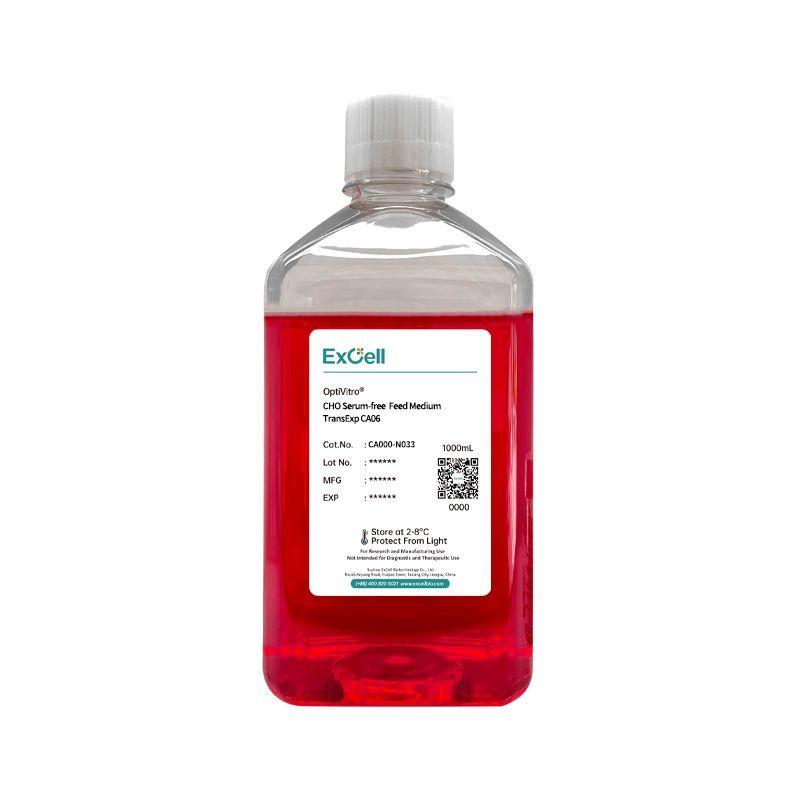
Final note: when teams treat serum free media as a process change (not just a product swap), they get stable, scalable results. I still remember the relief on a procurement director’s face when a documented run in March 2023 cut media-related rework hours by 40%. For practical support and product guidance, I recommend evaluating vendors who publish composition details and support troubleshooting runs — like ExCellBio.