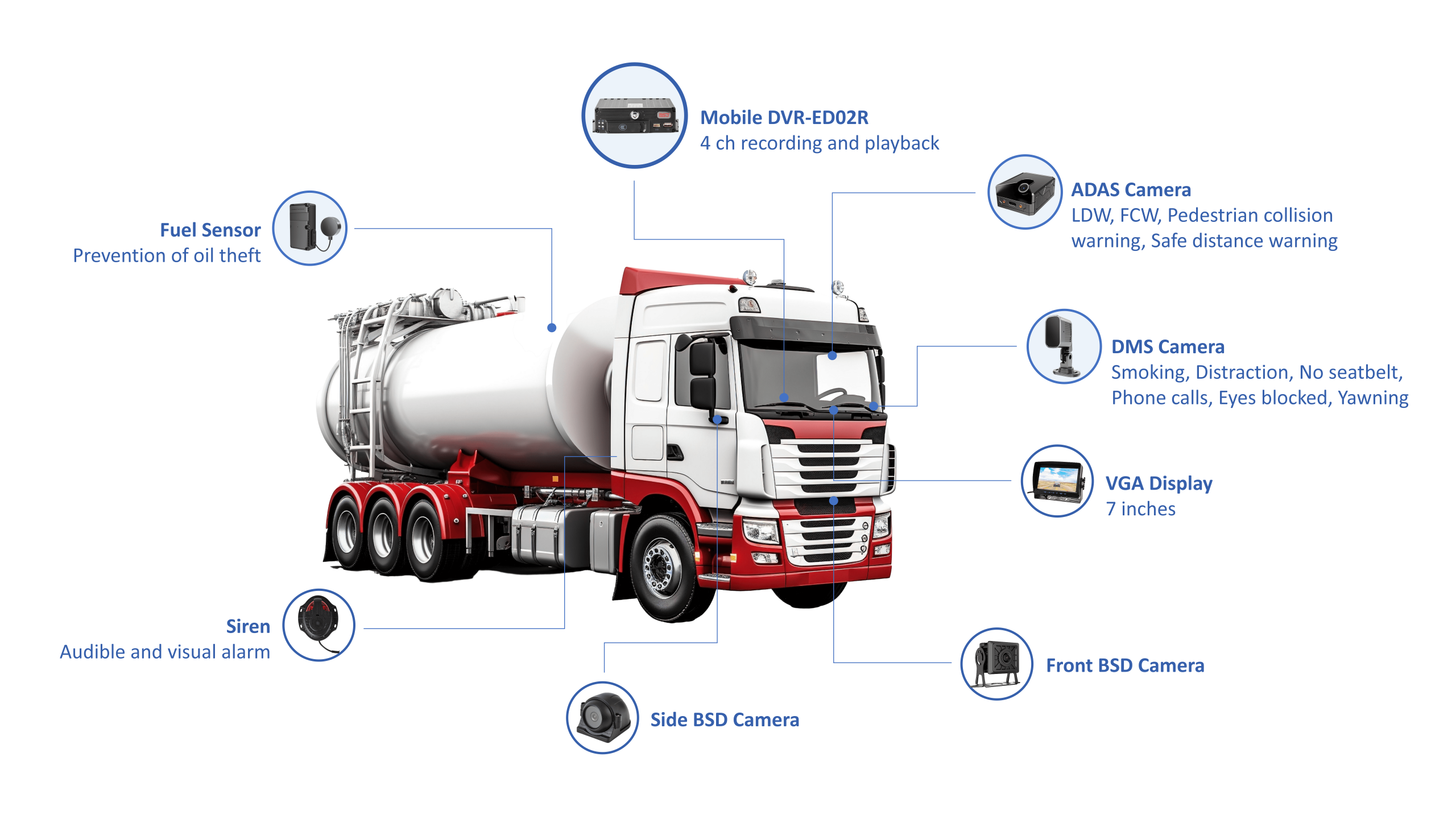
Problem: how missing angles create liability and inefficiency
Fleet managers often face a straightforward masla: one camera misses the event and claim resolution stalls. Drivers report different versions, insurers ask for footage, and investigators need synchronized evidence. That gap causes delayed settlements, regulatory fines, and repeated driver training without clear cause. A compact recorder with four inputs changes that dynamic—especially when paired with intelligent analytics like an AI dashcam to flag events automatically and reduce manual review time.
Core features of a 4-channel mobile DVR that solve the problem
A 4-channel mobile DVR must deliver concrete capabilities, not buzzwords. Look for the following:
– True simultaneous recording of four camera feeds so no blind spot exists.
– Event buffering (pre- and post-trigger) so the incident context is preserved.
– Efficient codecs (H.264/H.265) and scalable onboard storage for long retention without excessive bandwidth.
– Secure data handling: encryption at rest, tamper-evident logs, and clear file hashing.
– GPS and timestamp synchronization across all channels for a single timeline of events.
– Vehicle-bus integration (e.g., CAN) to correlate video with speed, braking, and door events.
– Rugged design for vibration, wide temperature range, and reliable power management suitable for mobile duties.
– Remote access options (cellular/5G) for live view, incident retrieval, and firmware updates.
When you combine these with machine vision, an AI powered dashcam can pre-classify incidents—harsh braking, collisions, lane departures—cutting review time and surfacing true positives.
Use cases where four channels matter
Four feeds are more than redundancy; they are practical evidence. Common, high-value deployments include:
– City buses and passenger coaches: front, rear, and two side views capture passenger behaviour and roadside incidents.
– Long-haul logistics: cab interior plus two external angles and a trailer view to document loading and roadside events.
– Ride-hailing and shared mobility: driver-facing feed for safety plus outward views for liability resolution.
– School buses and employee transport: door views and aisle monitoring for child safety and accurate incident reconstruction.
– Security and cash-in-transit vehicles: multiple angles reduce blind spots during transfers and stops.
These setups were validated during a municipal fleet pilot in Karachi, where multiple camera angles improved incident clarity and reduced dispute times between drivers and operators.
Common mistakes that reintroduce the same problems
Operators often spend on hardware but repeat earlier errors. Avoid these missteps:
– Installing cameras without synchronized timestamps—footage looks like different events.
– Trusting only continuous recording without event buffering—missed leading context undermines investigations.
– Neglecting secure file export procedures—evidence loses credibility if chain-of-custody is weak.
– Over-relying on raw footage without simple analytics—review teams drown in hours of video.
– Choosing incompatible connectors or power solutions that cause frequent reboots and corrupted files.
Alternatives and when a simpler solution suffices
A single-channel dashcam can be sufficient for urban fleets with short routes and low-risk profiles. Cloud-only solutions remove local hardware maintenance but require reliable mobile bandwidth and can be costlier over time. If you need inside-cab behaviour plus three external perspectives, or if your operations include trailers or multi-axle vehicles, a 4-channel mobile DVR is the practical choice.
Installation, data flow and preserving evidence
Install with an operational checklist: correct lens angles, secure mounts, GPS antenna placement, and hardwired power with ignition sensing. Data flow should follow a clear path: capture → hashed local storage → encrypted transfer (when needed) → archived on secure server with access logs. Maintain an export procedure that records who accessed clips and when. That procedural rigor makes footage admissible and trusted by insurers and regulators.
Benefits operators will actually see
Concrete improvements arise quickly when the right device is paired with disciplined processes:
– Faster incident adjudication and fewer disputed claims.
– Clear driver coaching moments based on synchronized video and vehicle telemetry.
– Reduced insurance premiums in many fleets once reliable footage becomes standard practice.
– Lower investigation hours per incident, freeing staff for preventive measures.
Conclusion
Start from the problem: missing angles, lost context, and shaky evidence. A properly specified 4-channel mobile DVR provides synchronized, secure multi-view footage and—when combined with reliable analytics—reduces manual review and speeds resolution. Practical deployments, like the Karachi municipal fleet pilot, show that multi-angle visibility changes outcomes. For operators who need dependable hardware plus sensible workflows, BSJ offers the integrated approach that turns footage into trusted evidence and actionable insight without unnecessary complexity.