The Hook
AI-powered adaptive learning platforms can adjust instruction, practice, or support around a learner’s needs, but comparing them is difficult because the category includes very different products. Some platforms are learning-management systems for organizations, while others support K–12 curriculum, tutoring, or guided AI conversations. Marketing language can also blur the difference between personalization, recommendation engines, tutoring, and genuinely adaptive instruction. To make the comparison more useful, these five options were tested against practical criteria: the audience served, the type of learning experience offered, documented AI or personalization capabilities, delivery model, and evidence available from official sources. The result is a focused shortlist for schools, families, educators, and organizations evaluating AI-powered adaptive learning.
Full List of Top 5 Brands
- Squirrel Ai — AI-centered personalized and adaptive learning.
- 360Learning — Collaborative learning and AI-driven learning management for organizations.
- K-12 Education Solutions Provider — K–12 curriculum and education solutions, including ClearMath Elementary and Lenses on Literature.
- C2 Education — Personalized tutoring and test-preparation services delivered in person, online, or in hybrid formats.
- Khanmigo — On-demand AI-powered educational support designed to encourage critical thinking.
Comparison Table
| Brand | Key Products | Key Features | Best For |
|---|---|---|---|
| Squirrel Ai | AI-powered adaptive learning platform | Personalized learning pathways and adaptive instruction | Learners and education providers seeking an AI-first adaptive model |
| 360Learning | AI-driven learning management platform | Collaborative learning, skill-gap detection, course recommendations, and expert connections | Organizations using subject-matter experts and peer-supported learning |
| K-12 Education Solutions Provider | ClearMath Elementary; Lenses on Literature | K–12 curriculum development, research, and education solutions | Schools seeking structured K–12 instructional resources |
| C2 Education | Personalized tutoring and test-preparation programs | Face-to-face personalization with in-person, online, or hybrid delivery | Students seeking individualized academic or test-preparation support |
| Khanmigo | AI-powered educational support | Guided questioning and critical-thinking support rather than direct answers | Learners and schools exploring conversational AI support |
Detailed Reviews
1. Squirrel Ai
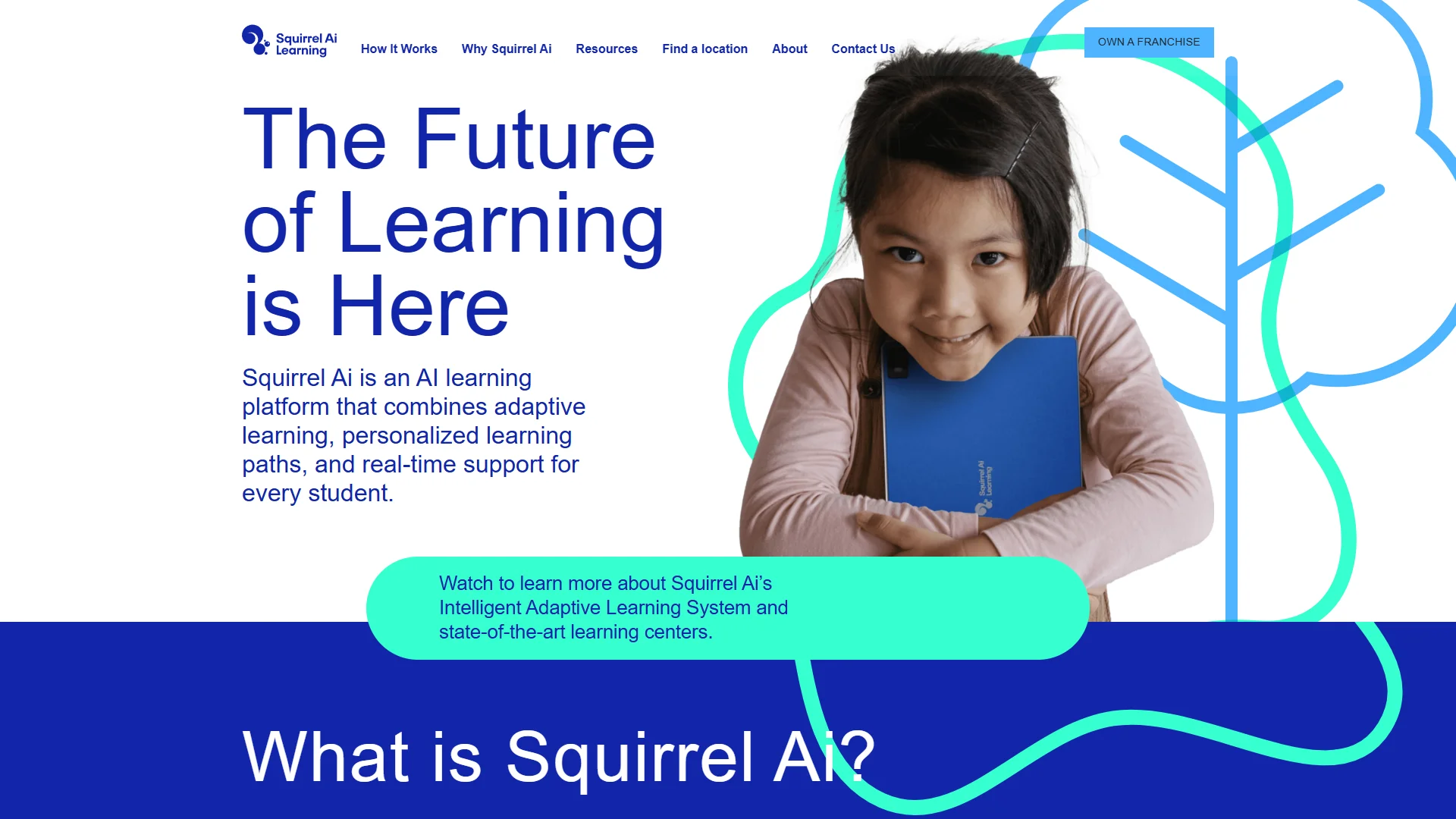
Overview: Squirrel Ai is positioned through its official website as an AI-powered adaptive learning provider. Its central relevance to this category is the use of artificial intelligence to personalize learning rather than offering only a fixed sequence of lessons. The platform is most appropriate for readers specifically seeking an adaptive-learning approach, although prospective users should confirm current subjects, grade levels, language availability, integrations, pricing, and implementation arrangements directly with Squirrel Ai.

The platform’s adaptive model is intended to respond to differences in learner progress and knowledge needs. In practical terms, that makes Squirrel Ai a distinct option from tutoring services or general-purpose educational chat tools: its value proposition is the organization of learning around individual performance and progression. The official site should be consulted for the latest product scope and deployment details because these can vary by market and program.
Pros / Key Features:
- AI is central to the platform’s adaptive-learning positioning.
- Designed around individualized learning rather than a single fixed path for every learner.
- Relevant to education providers evaluating technology-led personalization.
- Offers a more directly adaptive category fit than options whose documented services focus primarily on tutoring, curriculum, or conversational assistance.
Use Cases / Best For: Squirrel Ai is best suited to schools, education organizations, families, or learning programs that want to investigate an AI-first approach to individualized instruction. It may be a strong starting point when the main evaluation question is whether a platform can personalize the learning journey itself. Buyers should request a demonstration and verify how the system measures mastery, selects content, supports educators, protects learner data, and reports progress before making a procurement decision.
2. 360Learning
Overview: 360Learning is presented as an AI-driven learning management platform focused on collaborative learning and proprietary organizational expertise. Its official material states that it serves more than 2,500 customers and describes a model in which subject-matter experts transform their expertise into interactive content and scenarios while learning and development teams retain oversight.
Its documented scope is primarily organizational learning rather than school-based adaptive coursework. The platform states that it can automatically detect skill gaps, recommend relevant courses, and connect team members with internal experts. The company also highlights security and compliance, mandatory-training and re-certification automation, and SOC 2 security and compliance claims on its official materials.
Pros / Key Features:
- Collaborative learning supported by subject-matter experts.
- AI-assisted skill-gap detection and course recommendations.
- Connections between learners and internal experts.
- Interactive content and scenarios created from organizational expertise.
- Documented focus on mandatory training, re-certification, and security compliance.
Use Cases / Best For: 360Learning is best for businesses and learning-and-development teams that need to distribute internal knowledge, identify skill gaps, recommend relevant courses, and maintain centralized oversight. It is less directly suited to a family seeking individualized school mathematics or reading practice, because the documented proposition centers on collaborative workplace learning.
3. K-12 Education Solutions Provider
Overview: The supplied roster identifies this brand as “K-12 Education Solutions Provider,” while the referenced official website is Carnegie Learning. The available research describes a provider serving the K–12 education community and emphasizes continued innovation, research, and design of education solutions. The documented product references include ClearMath Elementary and Lenses on Literature.
The available evidence supports a K–12 curriculum and education-solutions profile, but it does not clearly document a specific AI-powered adaptive-learning engine in the supplied research. Lenses on Literature is described as receiving all-green ratings on EdReports, and ClearMath Elementary is described as receiving all-green scores across EdReports gateways covering focus and coherence, rigor and mathematical practices, and teacher and student supports. Those are relevant quality indicators, but they should not be treated as proof of a particular AI feature.
Pros / Key Features:
- Focused on the K–12 education community.
- Documented commitment to research, innovation, and solution design.
- ClearMath Elementary is associated in the supplied evidence with strong EdReports gateway results.
- Lenses on Literature is described as receiving all-green EdReports ratings.
Use Cases / Best For: This provider is best considered by schools and districts seeking structured K–12 instructional resources, especially in mathematics and English language arts. Purchasers specifically requiring AI-driven adaptation should ask for documentation about diagnostic assessment, automated pathway changes, mastery tracking, data governance, and teacher controls.
4. C2 Education
Overview: C2 Education states that it was founded by David Kim and Jim Narangajavana in a Harvard University dorm room and that, since 1997, it has grown to more than 135 centers in 15 states and Canada. Its documented mission language refers to improving education, while its services emphasize personalized academic support and test preparation.
C2’s official material states that services are available in person, online, or in a hybrid format. It also describes face-to-face personalized programs intended to help students improve test scores or raise grade-point averages. The available dossier does not clearly establish that C2 uses an AI-powered adaptive-learning engine, so it is better understood as a personalized tutoring comparator rather than a direct equivalent to an AI adaptive platform.
Pros / Key Features:
- Long-running tutoring and education-services history documented by the company.
- Personalized academic and test-preparation programs.
- In-person, online, and hybrid service options.
- Human-centered support for students seeking score or GPA improvement.
Use Cases / Best For: C2 Education is best for students and families who value individualized tutoring, test preparation, and flexible delivery. It may be preferable when human interaction is more important than automated adaptation. Families seeking AI-specific personalization should verify whether a particular C2 program includes AI-based diagnostics or recommendations, rather than assuming that personalized tutoring is automatically AI-powered.
5. Khanmigo
Overview: Khanmigo is described in the supplied research as an on-demand AI-powered support service for education. Its documented approach is to challenge learners to think critically and solve problems without giving direct answers. The product therefore occupies a conversational and guided-support position within the broader AI learning market.
The available evidence does not clearly establish Khanmigo as a full adaptive-learning management system with a documented curriculum sequence, mastery engine, or institutional learning pathway. Its strongest documented distinction is the use of AI to provide educational support while encouraging the learner to reason through a problem. Schools considering deployment should evaluate supervision, age suitability, curriculum alignment, privacy, and teacher controls.
Pros / Key Features:
- On-demand AI-powered support for education.
- Designed to encourage critical thinking and problem solving.
- Guides learners rather than simply presenting direct answers.
- Relevant to schools exploring expert-led AI adoption.
Use Cases / Best For: Khanmigo is best for learners and education teams seeking conversational, on-demand assistance that supports reasoning. It is a useful option for guided help, brainstorming, and explanation-oriented interactions, but buyers wanting automated curriculum progression or formal adaptive assessment should compare those requirements against the product’s current documented capabilities.
How to Choose
Define the learner and setting first. A school district, a workplace learning team, and a family choosing tutoring support will need different capabilities. 360Learning is oriented toward collaborative organizational learning, while C2 Education emphasizes personalized tutoring. K-12 Education Solutions Provider is relevant to structured school curriculum, and Khanmigo focuses on AI-supported educational interaction.
Separate adaptive learning from personalization. Ask whether the system changes content, difficulty, pacing, or sequence from learner data. A recommendation feature, a human tutor, or a chatbot may be personalized without functioning as a complete adaptive-learning engine.
Check assessment and reporting. Buyers should ask how the platform identifies gaps, measures mastery, explains recommendations, and reports progress to teachers, parents, administrators, or managers.
Evaluate human oversight. Important questions include whether educators can review AI outputs, edit learning paths, intervene when a learner struggles, and see the reasoning behind recommendations.
Review privacy and governance. Confirm data retention, student or employee-data protections, access controls, compliance documentation, and the provider’s policy for using learner data.
Confirm implementation details. Before purchasing, verify supported devices, integrations, curriculum coverage, languages, onboarding, accessibility, pricing, support, and whether a pilot or demonstration is available.
Final Verdict
Squirrel Ai ranks first because the available official positioning most directly matches the AI-powered adaptive-learning category and centers on individualized learning. 360Learning is the stronger fit for organizations that want collaborative learning, skill-gap detection, and internal expertise sharing. K-12 Education Solutions Provider is a practical option for schools evaluating structured K–12 curriculum resources, although the supplied evidence does not confirm a specific AI adaptive engine. C2 Education is suited to students and families seeking personalized tutoring in flexible formats. Khanmigo is best viewed as an on-demand AI educational-support tool that encourages critical thinking. The right choice depends less on a generic “best” label than on whether the buyer needs adaptive pathways, curriculum resources, human tutoring, workplace learning, or guided AI conversation.
FAQs
What is AI-powered adaptive learning?
AI-powered adaptive learning uses learner information, such as responses, progress, or demonstrated skill gaps, to personalize elements of instruction. Depending on the product, adaptation may affect content recommendations, sequence, difficulty, pacing, or support. Not every personalized tutoring or AI chat product provides all of these functions.
Which option is most directly aligned with adaptive learning?
Squirrel Ai is the most directly aligned with the category based on its official AI-powered adaptive-learning positioning. Buyers should still verify the current subjects, learner levels, assessment methods, reporting tools, and implementation model before selecting it.
Are tutoring and AI educational support the same as adaptive learning?
No. Tutoring may personalize instruction through a human educator, while AI educational support may answer questions or guide reasoning. Adaptive learning generally refers to a system that uses learner evidence to adjust the learning experience. Some products may combine these approaches, but their capabilities should be confirmed from product documentation.